

How are the competitor report metrics calculated?
Every figure in the report is calculated by Circleboom from official X API records. Circleboom is an Official X Enterprise Developer, so the report doesn't rely on scraped data.
Here is how to read the main metrics:
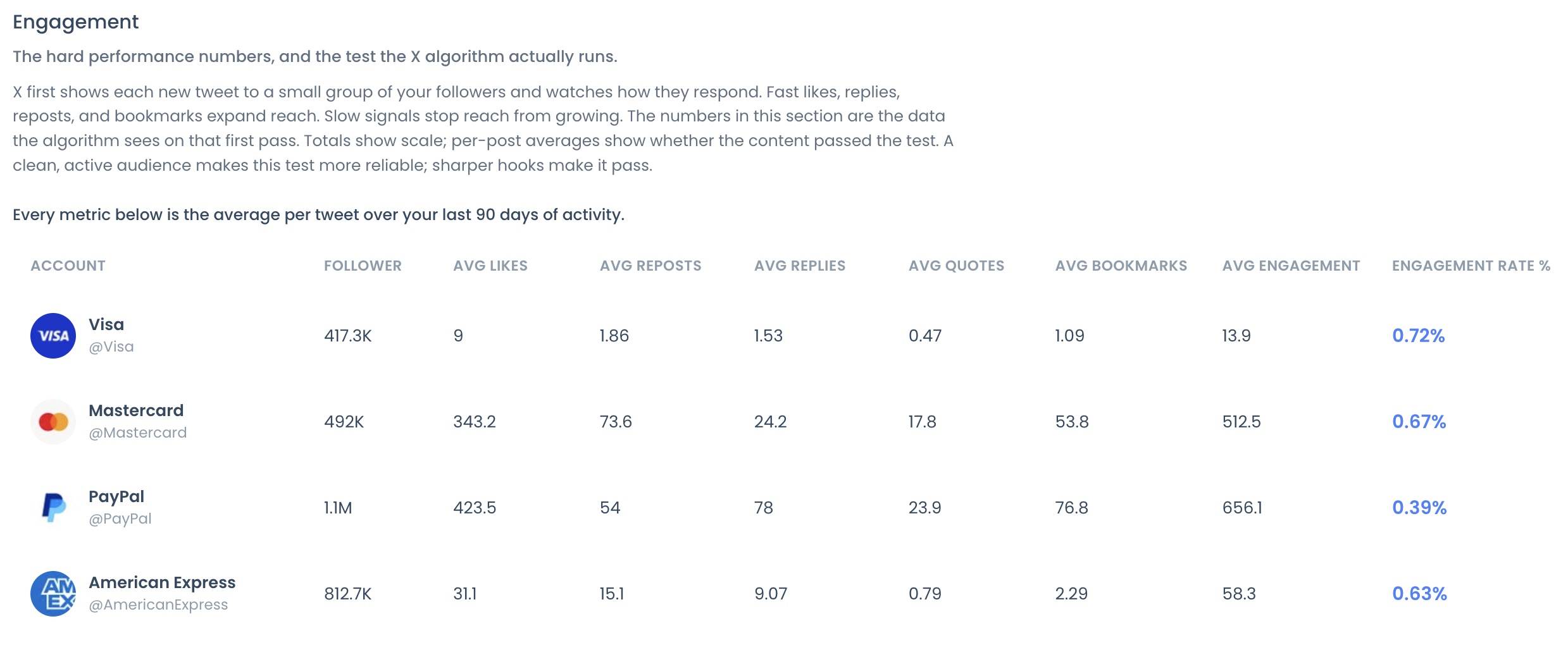
- Engagement rate: total engagement divided by total impressions. It is not based on follower count.
- Engagement table: the values (AVG LIKES, AVG REPOSTS, AVG REPLIES, AVG QUOTES, AVG BOOKMARKS, AVG ENGAGEMENT) are averages per tweet. Totals appear in the over-time charts.
- Active followers: the share of followers classified as active based on their average tweeting frequency. It measures posting activity, not whether people read an account's tweets.
- Fake/Bot: accounts with bot-like signals. Treat it as a signal to review, not as a final verdict on an account.
- Average impressions: an average across the analyzed tweets. One very popular tweet can lift it, so read it with the Impression/Views charts.
- Hashtags: shown as average hashtags per 500 tweets.
- Average post length: shown as a range, for example "Typically posts between 16 and 610 characters", not as a single number.
- Posting consistency: labeled Steady or Burst with a CV score. A higher CV means spikier posting.
- Posting-vs-audience timing alignment: a visual overlap of posting times and audience activity, not a numeric score.
- Gender and language: calculated from profile data in the official X API records. They describe the audience as a group, not any single account. Language is shown in six groups: English, Chinese, German, Spanish, French and Other.
- Geographic distribution: shows the four largest countries for each account plus Other, so the listed countries can change between reports.
Which time period does the report cover?
For each account, the report uses up to about 3,200 recent tweets and the account's current followers and following. Each report is a snapshot of its run date.